
From Kithara to Kilowatts: A Journey Through Guitar History
Published on April 18, 2025
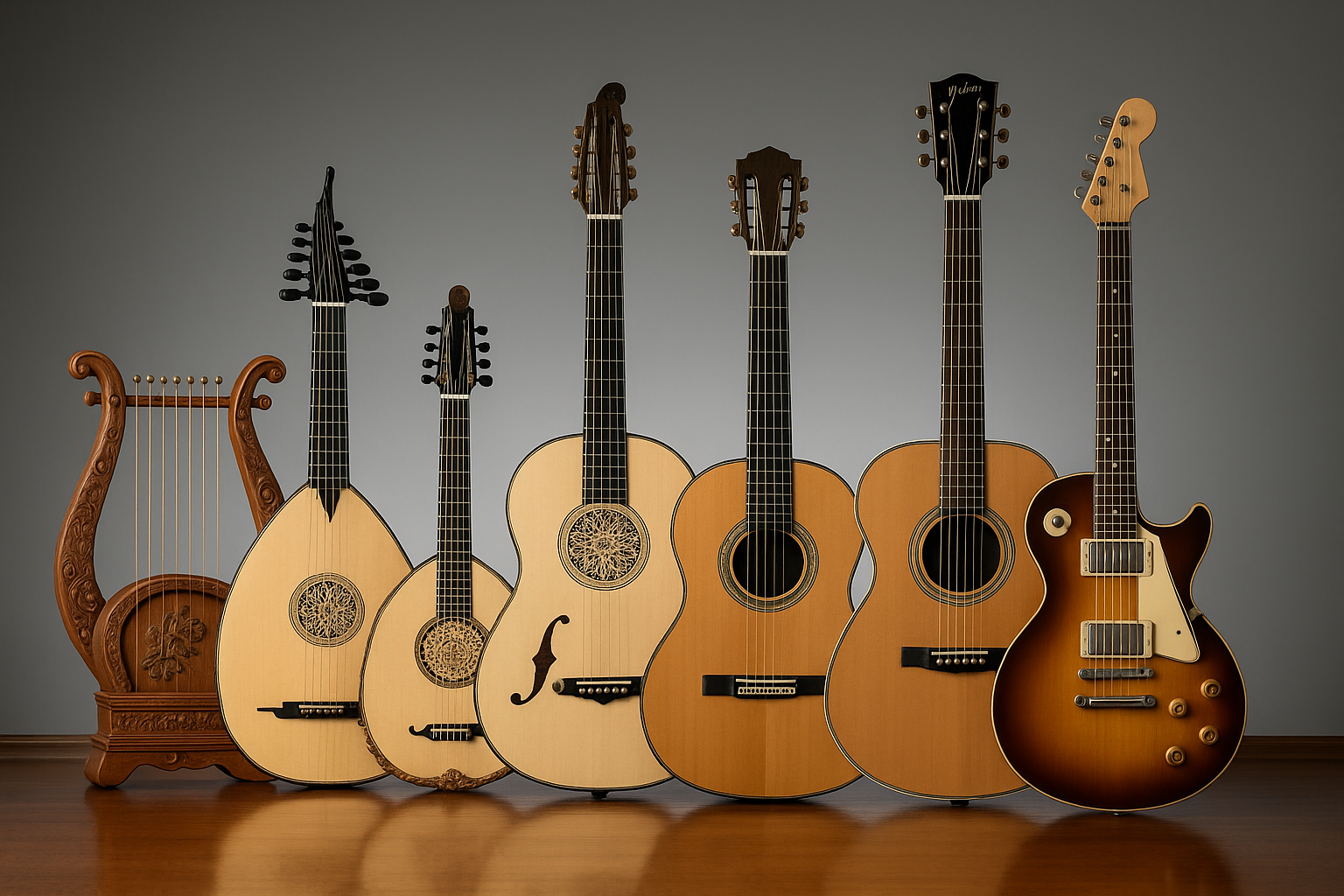
At SoundGate, we live and breathe audio. From the subtle nuances of a finely tuned acoustic to the earth-shaking power of a distorted electric, the sound of the guitar has shaped music for millennia. But how did we get from ancient lyres to the cutting-edge instruments we see today? Join us on a journey through the fascinating history of the guitar, exploring its ancestors, evolutions, and the echoes of influence that resonate through time.
The Ancient Roots: Kithara and Lyre
Our story begins not with a guitar, but with its distant relatives. The kithara and the lyre, ancient stringed instruments from Mesopotamia and Greece, represent some of the earliest known examples of plucked chordophones. While they lacked a neck and a resonating body in the modern sense, their core principle – vibrating strings producing musical notes – laid the groundwork. Imagine the sound of Homeric epics being recited to the strumming of a lyre; this was the genesis of stringed musical expression.
The Lute Family: A Crossroads of Innovation
Fast forward to the medieval period, and we encounter the sprawling lute family. Originating in the Middle East, the oud (from which "lute" derives its name) made its way to Europe and underwent numerous transformations. Lutes featured a rounded back, a fretted neck, and a distinct pegbox that bent back at an angle. Their versatility and rich tone made them immensely popular across various cultures.
The lute's influence on the guitar is undeniable. The concept of a fretted neck, the development of chordal playing, and the increasing complexity of musical compositions all evolved significantly with the lute. Its widespread use undoubtedly created a demand for similar, but perhaps simpler or more robust, instruments.
The Vihuela: Bridging the Gap
As the Renaissance blossomed, particularly in Spain, a crucial instrument emerged: the vihuela. Often described as a "guitar-shaped lute," the vihuela featured a flat back and sides, a more defined waist, and a shape that is strikingly familiar to the modern acoustic guitar. It was often tuned similarly to the lute but was played with a plectrum or fingers. The vihuela's form factor and playing techniques represent a significant step towards the guitar as we know it, demonstrating a clear design evolution driven by musical preference and ease of play.
The Baroque Guitar: Embracing Ornamentation
The 17th and 18th centuries saw the rise of the Baroque guitar. This instrument typically had five courses (sets of strings, usually paired), a smaller body than later guitars, and often featured intricate ornamentation. It was a popular instrument for both solo performance and accompaniment, particularly in Spain, France, and Italy. The Baroque guitar further refined the instrument's shape and expanded its repertoire, moving it further into the mainstream of musical performance.
The Classical and Romantic Guitars: Refinement and Virtuosity
By the late 18th and 19th centuries, the guitar began to shed its paired courses in favor of six single strings, a configuration that remains standard today. This era saw the emergence of the classical guitar, renowned for its elegant shape, fan bracing (a system of internal wood strips that enhances sound projection), and a rich, resonant tone. Virtuoso performers like Fernando Sor and Mauro Giuliani composed magnificent works for the instrument, elevating its status in the concert hall.
The classical guitar's evolution focused on maximizing its acoustic projection and tonal beauty, laying the groundwork for the construction techniques that would define acoustic guitars for centuries to come.
The Steel-String Acoustic: Power and Presence
As the 19th century gave way to the 20th, a significant innovation arrived: the widespread adoption of steel strings. While earlier guitars used gut strings, steel offered greater volume and a brighter, more cutting tone – essential for cutting through ensembles in a growing musical landscape. This led to the development of the steel-string acoustic guitar, with its reinforced neck and heavier bracing to withstand the increased tension. From folk and blues to country and pop, the steel-string acoustic became a ubiquitous instrument, defining the sound of countless genres. Companies like Martin and Gibson pioneered many of the designs that are still beloved today.
The Electric Revolution: Amplifying Possibilities
And then came the game-changer: electricity. The desire to amplify the guitar's sound, especially in big band settings where it was easily drowned out, led to experimentation with pickups. Early attempts involved attaching microphones to acoustic guitars, but true innovation arrived with the development of electromagnetic pickups that converted string vibrations directly into electrical signals.
The 1930s saw the birth of the first commercially successful electric guitars. Initially, these were often hollow-bodied instruments, essentially amplified acoustic guitars. However, feedback issues at higher volumes prompted the invention of the solid-body electric guitar in the 1940s and 50s by pioneers like Les Paul and Leo Fender.
The solid-body electric guitar was a revolution. It allowed for unprecedented volume, sustain, and the ability to manipulate the sound with effects pedals, opening up a vast new sonic palette. Rock and roll, blues, jazz, and countless other genres were irrevocably transformed by its arrival. From the searing solos of Jimi Hendrix to the intricate textures of modern prog, the electric guitar continues to evolve, pushing the boundaries of what's possible.
The Enduring Legacy
From the simple plucking of the kithara to the sophisticated circuitry of today's multi-effects pedals and digital guitar interfaces, the journey of the guitar is a testament to human ingenuity and the enduring power of music. Each iteration, from the lute's frets to the vihuela's shape, the classical guitar's elegance, and the electric guitar's raw power, built upon the innovations that came before it.
At SoundGate, we're proud to be a part of this ongoing evolution, creating audio technology that helps musicians push the boundaries of sound, connecting the ancient echoes of the kithara with the thrilling possibilities of tomorrow.